Learning Soroban: How the Japanese Abacus Builds Mental Math Superpowers
What Is Soroban?
The Soroban is the Japanese abacus, refined over centuries into one of the most efficient manual calculating tools ever built. Its real value today isn't the physical frame, it's the mental framework the training builds: a clear inner picture of numbers that lets practiced users add, subtract, multiply, and divide faster than most people can reach for a calculator.
> Ready to learn the Japanese abacus technique for speed? NumDojo's soroban lessons take you from your first bead to mental Anzan, with timed practice at every step.
A short history
Counting frames have existed for thousands of years, from the Roman hand-abacus to the Chinese suanpan. The soroban is the Japanese refinement of that lineage. Over time it shed the extra beads of older designs and settled on a lean layout: one bead above the bar and four below on each rod. That simplicity is the point. Fewer beads mean fewer movements, and fewer movements mean more speed and a cleaner mental image. Soroban is still taught in Japanese schools and abacus clubs, and mental-abacus training has since spread around the world.
How the Soroban Works
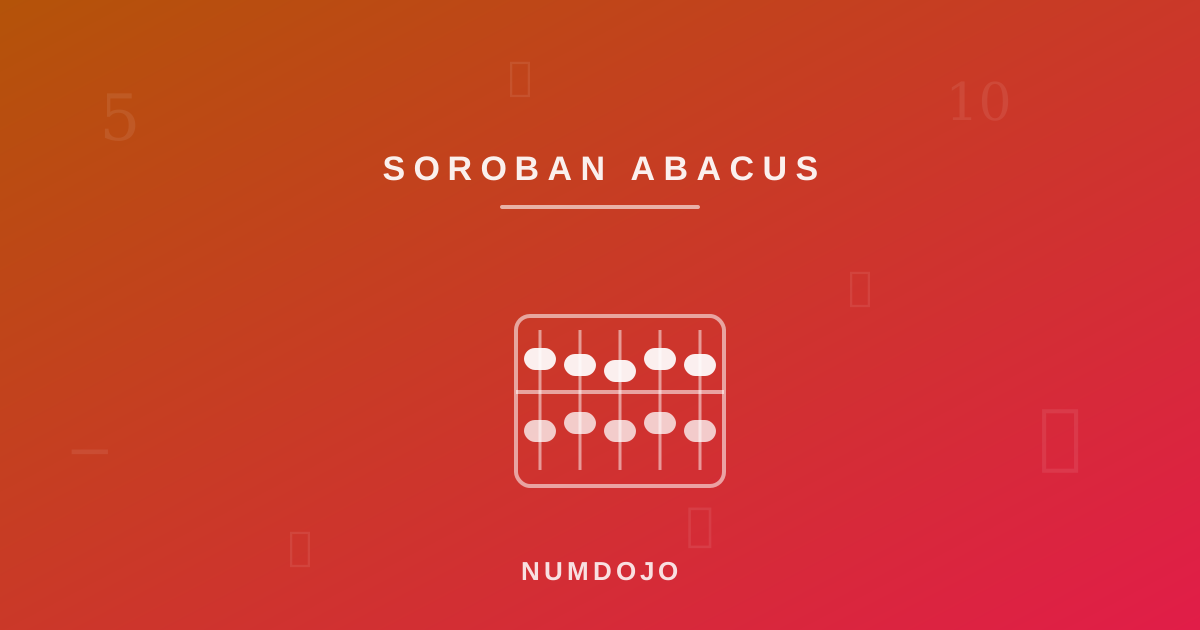
A standard Soroban has:
- Rods representing place values (ones, tens, hundreds, etc.)
- Heaven beads (1 per rod, value = 5)
- Earth beads (4 per rod, value = 1 each)
Each rod can represent digits 0-9 by combining heaven and earth beads.
Reading a number
Say you want to show 7 on a single rod. Slide the heaven bead down to the bar, which is 5, then slide two earth beads up to the bar, which adds 2. Five plus two is seven. To show 3, you would slide up three earth beads and leave the heaven bead alone. Because each rod handles one place value, larger numbers simply use more rods to the left.
Addition with complements
The soroban's real cleverness shows up when a rod runs out of beads. Instead of stopping, you use a complement, a small swap that keeps the arithmetic moving.
Five's complement. To add 3 to a rod that already shows 4, there are no spare earth beads. Use the fact that 3 = 5 - 2: slide the heaven bead down to add 5, then clear 2 earth beads to take away 2. The rod moves from 4 to 7 in one motion.
Ten's complement. To add 6 to a rod showing 7, there again are not enough beads. Use 6 = 10 - 4: add one bead on the tens rod to the left, then clear 4 from the current rod. The 7 becomes 3, the tens rod shows 1, and you read the result as 13.
These two swaps, practiced until they are automatic, are the whole secret to soroban speed. Every operation is built from them.
From physical beads to mental math
The training moves through three stages:
- Beginner: you move real beads while you calculate, learning the fixed finger patterns for each operation.
- Intermediate: the beads disappear but your fingers still move, tracing an imaginary frame in the air.
- Advanced: you calculate entirely in your head, holding a mental picture of the beads. This mental stage is called anzan.
Anzan is where soroban students pull ahead of calculators on long addition. World-class practitioners can add fifteen three-digit numbers flashed for about a second and a half each, entirely in their heads, because they are not really working in words. They are watching beads move on a board only they can see.
Flash Anzan
Flash Anzan is the competitive form of mental abacus work. Numbers flash on a screen one after another at high speed, each person keeps a running total on their mental soroban, and only the final answer is typed in. It looks impossible from the outside, and it becomes possible only because the underlying bead movements have been practiced to the point of reflex. NumDojo includes a Flash Anzan trainer with adjustable speed and difficulty so you can build up to it a step at a time.
What the training builds beyond arithmetic
- Working memory: holding and updating a mental image strengthens short-term memory.
- Concentration: the practice demands sustained focus, which builds attention span.
- Processing speed: repeated fast calculation trains the brain to handle information more quickly.
- Spatial reasoning: picturing beads in space strengthens the visual and spatial skills that carry into other subjects.
These are the reasons many parents and schools value abacus training even for children who will rarely touch a physical soroban again.
Building the mental picture
The jump from moving beads to picturing them is the part that feels hardest, and it rewards patience. A few habits help. Work slowly at first and let the image form, because speed arrives on its own later. Picture the same soroban every time, in the same spot, so the layout becomes familiar. When you lose the image, drop back to a physical or on-screen soroban for a session, then try again. The goal is not to force the picture but to practice it until it appears without effort.
Accuracy before speed
It is tempting to chase fast times early, but speed built on shaky technique tends to collapse under pressure. Get each movement right first, then let a timer nudge you faster once the steps are reliable. Track accuracy alongside speed, and treat a drop in accuracy as a signal to slow down rather than push harder. Steady, correct practice is what turns into real speed later.
Who it is for
Soroban suits a wide range of ages. Children as young as seven or eight can start with physical beads and simple addition, and the mental stages build gradually from there. Teenagers and adults learn the same way; the progression is identical, only the pace differs. Because early wins come quickly, the method tends to build confidence fast, which keeps learners coming back.
A simple way to start
- Spend the first sessions just moving beads and reading numbers until the layout feels natural.
- Learn the five's and ten's complements for addition, then apply the same ideas to subtraction.
- Practice in short daily sessions rather than long occasional ones. Ten focused minutes a day is plenty at the start.
- Move to mental practice only once the physical movements feel automatic. Rushing the mental stage is the most common way to stall.
Subtraction with complements
Subtraction uses the same complements in reverse. Take 13 - 6. The ones rod shows 3 and the tens rod shows 1, but you cannot take 6 from 3 directly. Use the ten's complement again: to subtract 6, subtract 10 and add back 4. Clear one bead from the tens rod and add 4 to the ones rod. The tens rod drops to 0, the ones rod rises from 3 to 7, and the answer is 7. Once addition feels automatic, subtraction is the same move run backwards.
From addition to multiplication and division
Multiplication and division on the soroban are built from the addition and subtraction you already know. To multiply, you work through the digits and place each partial product on the correct rods, adding as you go. To divide, you repeatedly subtract and record the result rod by rod. Nothing new is required at the bead level, which is why a solid foundation in addition pays off across every operation.
A realistic timeline
Progress is steady rather than sudden. Most learners can read numbers and do simple bead addition within the first week or two. Reliable mental anzan on two and three digit numbers usually takes a few months of short daily practice. The learners who get there are almost always the ones who practiced a little every day, not the ones who crammed. Treat it like a musical instrument: frequency matters more than the length of any single session.
Common questions
Do I need a physical soroban to start? A real soroban helps early because moving beads teaches the finger patterns, but many learners begin on screen and move to mental practice quickly.
Am I too old to learn? No. Adults follow the same path children do. The rules are identical; only the pace differs.
How is this different from doing math in my head the usual way? Most people calculate in words, which is slow and easy to lose track of. Soroban replaces the words with a visual model, and a picture is far quicker to update than an inner voice.
Getting Started with Soroban on NumDojo
Our Soroban curriculum starts with basic bead manipulation and progresses through addition, subtraction, multiplication, and division, all the way to mental anzan practice. Every stage is broken into short lessons, so you always know the next step and your progress is saved as you go. Start the free Soroban unit, or see Vedic vs Trachtenberg vs Soroban.
Ready to practice?
Apply these techniques with interactive lessons and timed practice on NumDojo.
Start Learning